Monday, 28 March 2016

Learning to be Literate

      - Nomita (Curriculum Support & Facilitator)
         7-year old Samanya lives in the middle of a field under a tarpaulin sheet, insignificantly tucked away from all the urban action. Samanya’s mother is a scavenger. Three months ago, Samanya wandered into our learning centre, not far away from her little home. Her hair was uncombed and matted, framing her beautiful face that quickly broke into a smile! The sparkling black eyes, the dangling earrings and nose-pin added to her charm. She invited herself into the classroom and sat down, her thick silver anklets tinkling musically. Thus began Gubbachi’s engagement with Samanya! (You came across her in this post by Deyone)
      Every morning, Samanya is here an hour before all other children and is often playing on the slide when we arrive. She quickly runs to help us, singing as she opens windows, straightens slates, chalk and paper. Samanya sings her own songs, often weaving the Circle-time song learnt at Gubbachi, with other songs. The languages are mixed too - Kannada with Tamil (her own language). She has a beautiful voice and her singing brings a calm to the beginning of the day. She settles down around the children’s books or sometimes writes on the board or the painted wall surfaces until the other children arrive.
     Days pass, she moves on in the program, first through the early learning centre activities, building her social skills, learning to communicate in the languages of the other children, developing her fine motor skills, pre-numeracy and pre-literacy concepts. Her morning writing moves from squiggles, to scribbles, to more defined shapes that resemble inverted 2s, 5s, 7s, other numerals and Akshara-like shapes. She is beginning to recognise the symbols of print in her environment and imitate them – both numbers and letters.
     One morning she walks up to me and produces a jewellery catalogue! She asks me to read it. I look at the page in front and point to the necklace in the picture, “Isn’t this necklace pretty?!” She frowns at me, and points to the text on the page and demands “Read this!” So I began reading, “The price of gold as determined by …”. Her face lights up! She was happy and satisfied. She snatched the catalogue back and sat down to read it.
     Could it be that I just confirmed to her what she suspected, that the text had a relationship to the spoken? And … that the written word could be read and … had some meaning! This is an important learning that emergent literacy talks about. Making symbol (text) to sound connections, and connecting to meaning. Her engagement with text continues. She gets books to the centre that her mother scavenges. Next was a note book of some hapless engineering student. The graphs she amusingly reads as “haavu” (snake) for a sine curve. Another graph is “aane” (elephant), and so on! The circuit diagrams are “bus” to her! She now demonstrates that pictures and text both hold meaning. Samanya has begun reading!
     A few weeks later Samanya begins writing her name in Kannada and English. That’s where she struggles! Her fine motor skills are yet developing. What helps her grip is writing with chalk on board and with coloured crayon on paper. She writes but the letters are inverted. She struggles to move her hand back to form the curve for the ‘S’. What she does, interestingly enough, is to accommodate this challenge using a lying down ‘S’ like a sine curve. To correct her orientation, we try various techniques like tracing the letters on the floor and placing stones in the direction of writing. Next she runs her index finger on sand letters before attempting to write. She still makes errors. Demonstrating to her while verbalising how the shape is formed seems to help her best. I show and tell her how I am writing the letter. Saying, “I’m now moving my hand back to make the last curve of ‘S’.” This helps her. The very next stroke she attempts is right! She sports a wide grin! All she needs now is repeated practise to master the letter.
    Typically, we’d expect a 7-year old to do this quite easily. However, while Samanya has a rich repertoire of oral songs and stories, and ingenious, independent methods to further her own learning, she has never before written on paper. While listening, speaking and learning are innate; reading and writing needs to be taught. Pre-schools spend months and years readying children for reading and writing. Here, time is not a luxury - bridging learning gaps for getting children ready for mainstream schooling to an age appropriate level means only one thing. Trying to do the most in the least time.

    Policy decides that 6 months of bridging is optimum. How practical is it to look at the bridge program as a ‘crash course’ when accumulated deficiencies are to be ‘bridged’? When many lost years are to be made up in 6 months? Something that needs thought at the policy level.

Saturday, 5 March 2016

One Size Doesn't Fit All

                                                                                                  - Mani (Early Child Care & Curriculum Support)
There have been many times when I have walked into a public toilet in a railway station or a bus stand and walked out unable to use it. I have always wondered why people defecated all over the floor instead of inside the toilet bowl. Now I know why this happens.
At Gubbachi, once we had our water in place, and the toilets were actually fully functional, we thought things will be easy. A few mornings later the Akka’s, helping with the little ones, went to clean the toilets before the children were to use it. We did not see them for close to an hour. When they did show up later we were told they were delayed because there was shit all over the toilet floor.
As we got to the ‘bottom’ of it we realized that the little ones (3 to 6 year olds) were terrified to use the toilet. They feared they would fall into the bowl. The regular sized Indian toilet bowl was too large for them. Usually the Akka’s cajoled them into using the bowl, ensuring they will hold them and that they would not fall. This was not a foolproof method as the ‘urgent’ ones could not hold till they were suitably convinced that the hole would not swallow them up.
Also one Akka and 4-5 children meant she could not be there for every child. In the absence of the Akka’s the children generally used the floor in the toilet to finish their ‘jobs’. This means that everytime a child wants to use the toilet they had to be accompanied by Akka. On days Akka is absent or otherwise occupied, the child does not think twice about running behind the bushes and answering natures call.
When we are talking about Souchalayas for all, are we thinking about the user?...our little ones for example J

Sunday, 7 February 2016

My Role as a Facilitator of Learning

      - Deyone (Centre Co-ordinator and Facilitator)  
        This post is a collection of highs of my experience at the centre while I struggle to facilitate learning of some sort…learning which is meaningful and relevant to the set of learners entrusted to me…
       One of the happiest moments for me is a 7 year old girl playing at the 'see- saw' at the end of the day after the classes are over without worrying about taking care of her two younger siblings who are 4 years and 2 years old. All through the day she has been religiously catering to the needs of the two siblings as she engaged with the learning experiences of the day. It seems to be her time to let her hair loose …similar to a mum …a role that this little mum is truly true to.
      Another equally happy moment is in the morning just after I reach school: the first child to enter the school is Samanya. She loves to sing without a care in the world before her friends come to school, while she reads through the books or work with the puzzles; All this while I prepare for  my classes enjoying her songs in the background. My blissfull start to the day!
     Multilingual class is our reality. There are Hindi, Marathi, Tamil, Telagu and Kannada speaking children at our centre. One of our Hindi speaking child was much afraid of 'kannada speaking people' due to several stories she had heard and her experience in a city school. Truly speaking, she is a Bengali speaking child who sought comfort in Hindi since she could communicate with more people. Now, the interesting thing is, she has Kannada speaking friends in the centre and she formally learns Kannada and has picked up substantial amount of Kannada in 4 months. She now blends Kannada and Hindi together to communicate and fearlessly express herself. “Oottakku jao” is her blended phrase for “go for lunch”. Her friends, good-naturedly, encourage her to speak more Kannada. Yes, I am learning tolerance and cooperation from the children I am working with.
        A fish that flies a kite: This is what a 6 year old in my class drew during one of the free drawing sessions.
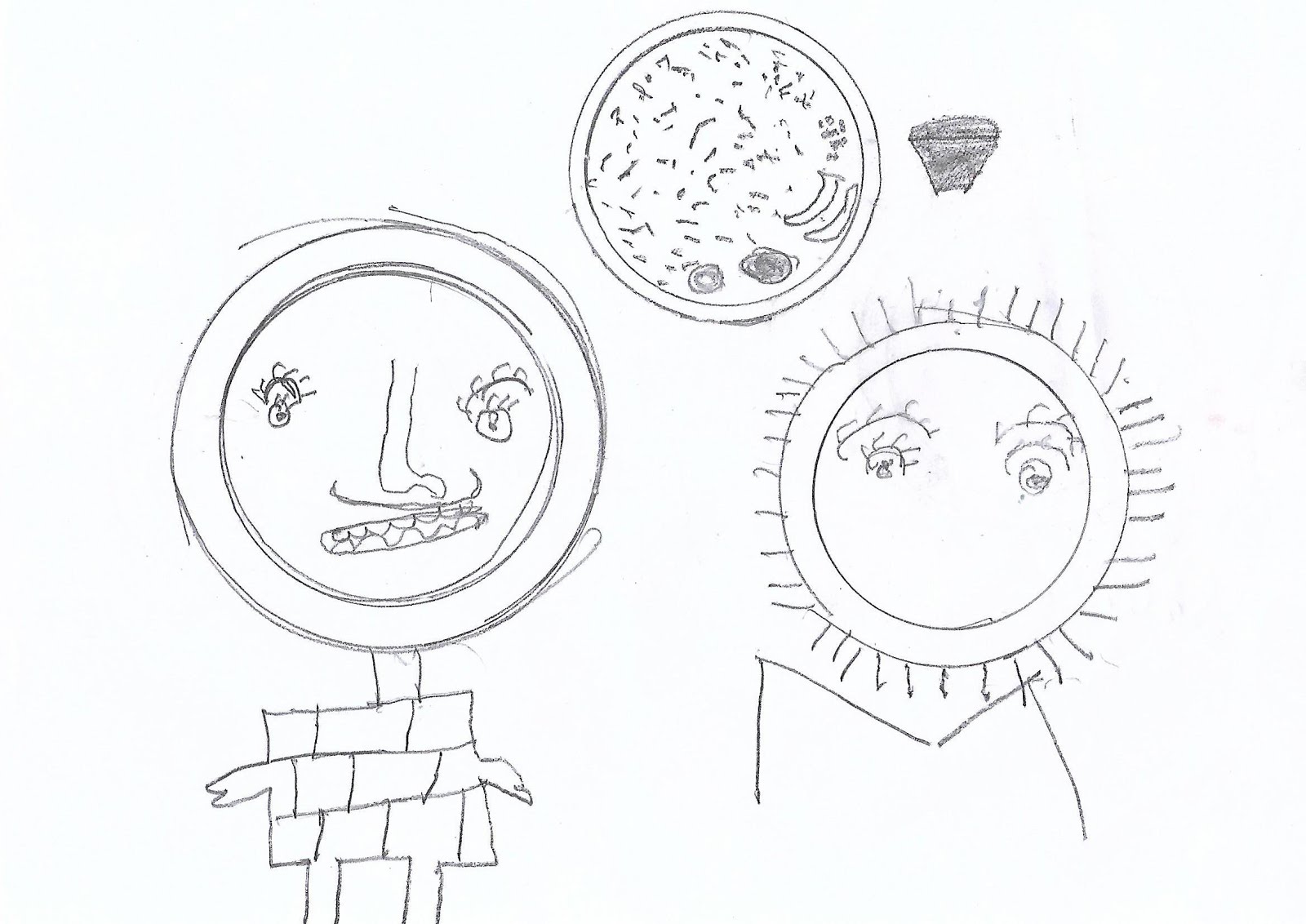
        I used to think children want to play a lot. Now I realize that children want to draw also as much. I see it everyday. They want to either play or draw if they are not attending any class (or even while they are attending a class). Most of the children at Gubbachi are unschooled or schooled sporadically. Most of the children in my class don't know how to read or write but they draw till the resources or time get exhausted.
       So then the question is why can all the learning not happen through these two activities: play and drawing. This is one question I'm facing as a facilitator of children's learning. I am looking forward to finding answer to many such questions as we evolve our practices for the centre!


Learning in and from Art Experience


- Vasundhara (Art Therapist)          

         I spent some time thinking about the kids I was going to work with before starting my sessions with them. Since they are children of migrant workers I thought construction noises, sand, mud, bricks, crowds, dust is what their surroundings would consist of; moving from city to city would be a big part of their life. The word that came to my mind was `Disconnect` and that is what I decided to work on with them.

           The art sessions I do with them are about making connections, relating to things that they can find wherever they go. Nature, the sky, sun, stars, soil, trees, water…these form the base of our sessions. The activities we do are about observing, thinking and expressing. Since these children have been in and out of school they tend to work with whatever they have been taught to draw; which is mostly flowers, Indian flag and gods. But when we begin to sing little rhymes, and play games that lead us into using colours and pencils, I can see little thought bubbles emerging.  
         The first few minutes (quite a few minutes actually) are spent trying to get everyone into the class and to settle into a circle. We do a small round of calming with pebbles where they feel the texture , temperature,  shape of the pebble they are holding. They love to tell us that the pebbles remind them of-  mobiles,  gulab jamun, soap, biscuit etc. A little struggle with calming down, a little translation into the proper kannada words and they rush to start their activity. I have found that a small trigger to their thoughts and colours in their hand is what it takes for them to settle. In all the chaos and noise we do encounter a few minutes of silence, a sudden hush.. all of them engrossed in what they are doing...it is a short but satisfying silence before the restlessness sets in again. Sometimes more chaotic than what we started the session with.
          I have been pleasantly surprised (in most of the sessions) by their observation skills- try asking an average kid going to a regular school what the colour of water is. “Blue” would be the most likely answer. Ever noticed that water is painted blue only in picture books. At Gubbachi these kids told me water has no colour, some said white, some said it becomes the colour of whatever is added to it, but no one said blue. That left me pondering. 
          
          The children have actual experiences of things other kids might only read or hear about. It is heartening to see their readiness to learn in spite of squabbles and tiffs that quickly change to warm smiles and happy laughter or the other way round. There is a willingness to create something, to express, to talk about what they draw. And to proudly display their art work.

          I am learning to give triggers and step back. Let them think, express, say what they want to, shed their inhibitions and create freely. I am also learning to listen to them, to what is really unfolding in their heads. Past few months have been a little trip of learning and unlearning for them and for me, but mostly it`s been an interesting exploration of little stories that emerge when we have scissors, paints, paper and glue to guide us and I`m looking forward to more.

What Everyday Stories Can Tell Us about Language Learning


       - Nomita (Curriculum Support & Facilitator)
     A Bridge Learning Program (or Special Training as it is officially referred to) aims to bridge the learning gaps (as per prescribed syllabus) in literacy and numeracy so that out-of-school children are able to access mainstream schools. If I have to reflect on the work that we have done in the past four months in the bridge program for children of migrant labour many stories come to the surface. Often we view these as interesting and fun episodes to enjoy or relate to others. But, these are events that can often give us powerful messages.
    Here, I recount one such story and the message it has for us as practitioners. A message that is established in research circles, but little understood by practitioners, educators, policy makers or even parents in India today. The latter often vociferously demanding “English medium” education for their wards in their early years - even before they have built a strong sense of their own home language! 
3 year-old Rahul (or Lahul as he calls himself) is from Bihar and his older brother is in the bridge program. Wearing a tiger print, warm, felt jacket, he plays around us and we strike up a conversation in Hindi – Lahul’s home language.

            Actual interaction in Hindi:
We:     "Yeh kaunsa sher hai?!"
Lahul:  "Main shel nahin hoon - Yeh to jacket hai!"
We:     "Theekh hai. Yeh kahani suno. Ek sher tha. Usne ek chote choohe ko dekha. Phir …  ab aap sunao."
Lahul:   "Phil …Shel ne choohe ko kha liya"
We:     "Itni jaldi?!! Theekh hai (smiling). Phir … sher ke paet mein chota chooha rone laga. Phir …?"
Lahul: "Phil …Shel ne kaha, 'mele paet mein choohe daud lahe hain!' … "  (The idiomatic meaning – “I am hungry!”))
We:     Amazed and tickled by this response.
English Translation:
We:     "Who is this tiger?!
Lahul:  "I am not a tiger – this is a jacket!"
We:     "Okay. Listen to this story. There was a tiger. He saw a little mouse. Then …now you tell me."
Lahul:   "Then …the tiger ate the mouse."
We:     "So quickly! Okay! (smiling) Then … in the tiger’s stomach the little mouse began to cry. Then …?"
Lahul: "Then … The tiger said, 'mice are running around in my stomach' "(The idiomatic meaning – “I am hungry!”)
We:     Amazed and tickled by this response.
This story building exchange goes on for a few more exchanges. 
Why were we amazed? The use of idioms adds colour to a language and induces interest in the listener. This is the cultural aspect that languages are embedded with, which native speakers use naturally and powerfully to convey meaning. Lahul’s response, “Shel ne kaha, “mere paet mein choohe daud lahe hain!” shows rich language being used by a three year-old.
If we look at the ‘enacted’ policy of most mainstream schools – private or public – languages that are not the medium of instruction – English or Kannada (in Karnataka) are not ‘allowed’ to be spoken in schools or even pre-schools! The rich knowledge that the child comes with is seldom acknowledged and usually ignored.
“Speak in English!” or even “Kannadadali matanaḍu!” If this was told to our Lahul, we would have silenced him completely! There would have been no story to build, no story to tell, no lessons to learn, no appreciation of the child’s knowledge, no opportunity for him to express his creativity, and no opportunity to communicate with confidence! How often have we heard, “these children do not know anything”! Shaking the very confidence of the child and creating a discomfort with her own identity in public space. Nip it (the creativity) in the bud, as our colonisers did! Mimicking the other, without understanding, becomes one way of coping.
The Indian classroom is a complex one – with a multi-lingual environment being the reality. Far from celebrating this rich diversity, we brush it aside to adopt ‘English’ as our ‘best’ solution! Recently, owing to market pressure, many policy makers have decided that English-medium is the way forward - even in public schools where most children come from homes and environments where English is not heard at all. Isn’t it saddening that we have few creative solutions to offer, not trusting enough to look at small experiments that have shown success in introducing English effectively, while using a multilingual approach.
English is the language of power undeniably and no child should be denied the opportunity to participate equally. So, what is the problem? Few teachers in the system have knowledge or pedagogic competency in English language teaching, especially when it is a foreign language. When we haven’t built the competency of teachers what outcome do we envision for our students! By providing low quality language learning, we instead determine who is excluded. We must allow for ‘free choice’ but let it be an opportunity of ‘fair chance’ too!
More dangerously, we affect the thinking abilities of the child. For it is strong competency in any language – which is but a ‘tool’ to think and communicate meaningfully - that allows one to listen, speak, read and write effectively! These are aspects that help in the making of a ‘rational, thinking being’ (an important aim of education) – not ‘English medium’ by itself.
What could this mean for us in the long term and as a nation? Could it mean that we are running the risk of systematically silencing masses and masses of children? Systematically killing the sense of self-worth in our children! Systematically killing our own ways of expressing! Systematically eradicating our own culture and our own unique ways of thinking critically and creatively? For isn’t language both a means of cultural expression and a tool of the mind? Are we systematically killing innovation by bending backwards to accommodate market forces? Make in India or should it be Replicate in India – as we so cleverly and uncritically have done in the past and continue to do!
Yet, we bow to market pressures and parental demand; instead of finding better solutions we apply quick-fix to a broken argument and roll out policies that can have damaging consequences for the child!
The larger question is : should policy-making be restricted to sloganeering or even an appeasement exercise? Or should it be an exercise in educating ourselves, celebrating our own rich diversity of languages, giving them an equal opportunity to flourish and grow; while collaborating with those organisations that have developed pedagogic knowledge over the years in English language instruction as a foreign language. Build competency in the system and systematically take the right step forward-slowly, yet surely!